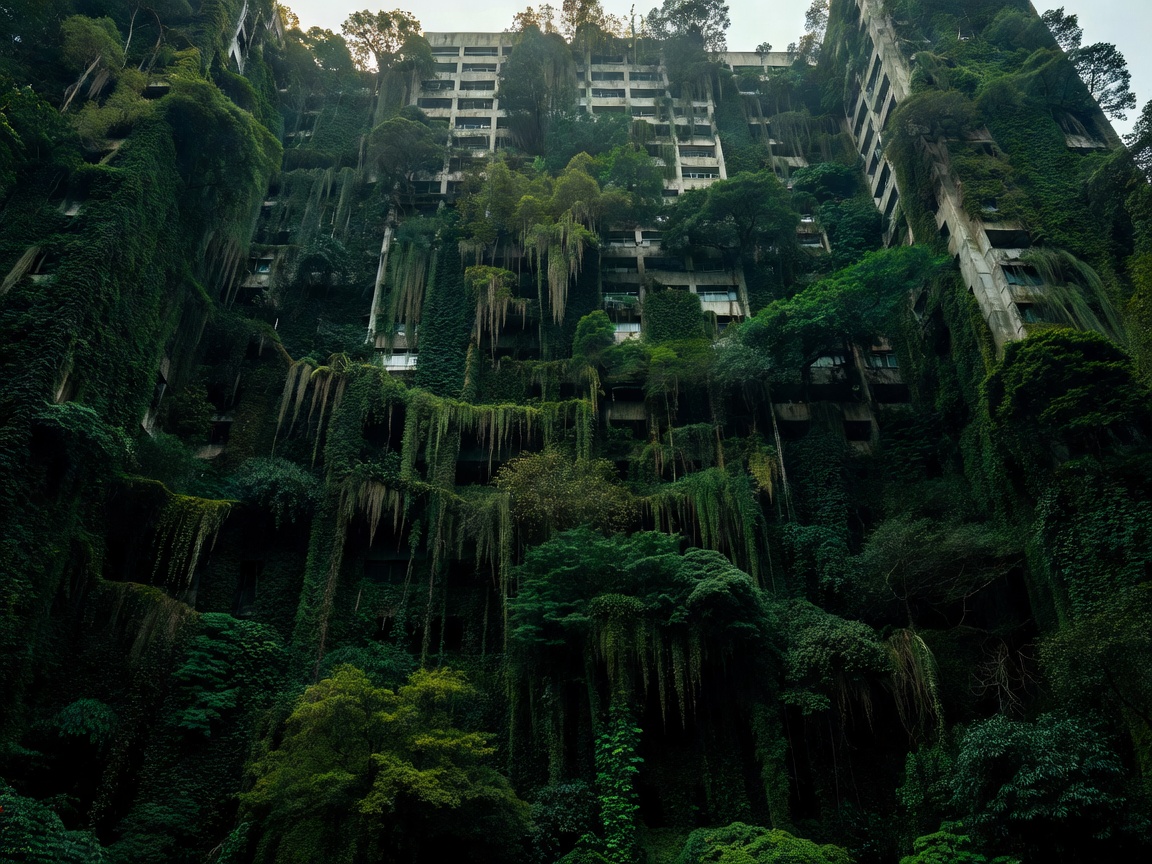
The Utility of Brutalism
Glass towers are thermal nightmares. The sustainable city abandons the all-glass skyscraper in favor of heavy, high-thermal-mass materials. Concrete, rammed earth, and engineered timber absorb heat during the day and release it at night, drastically reducing the demand on HVAC systems. This functionalist approach births a new architectural era: Moody Brutalist Sand and Stone, where structures feel anchored, heavy, and purposeful.
Vertical Forests: The Biological Facade
Structures like Stefano Boeri’s Bosco Verticale in Milan are not mere aesthetic statements; they are functional biological machines. High-density tree and shrub layers integrated into deep concrete balconies filter fine dust particles, absorb CO2, and create a localized microclimate that drops ambient surface temperatures by up to 30 degrees. The building becomes a functioning lung for the metropolis.
Passive House Standards at Scale
The airtight envelope is mandatory. Scaling the Passive House (Passivhaus) standard to commercial megastructures ensures thermal sovereignty. Thick insulation layers, triple-glazed minimized fenestration, and mechanical heat recovery ventilation (MHRV) maintain internal temperatures with near-zero energy input. A building that cannot maintain homeostasis without constant external power is classified as an architectural hazard.
Biomaterials and Structural Growth
Beyond concrete, the integration of mycelium insulation and algae-infused cladding represents the next evolution. Algae panels capture solar energy and CO2 to produce biomass, which can be harvested for biofuel. The building ceases to be a static object and becomes a biologically active participant in the urban ecosystem.